
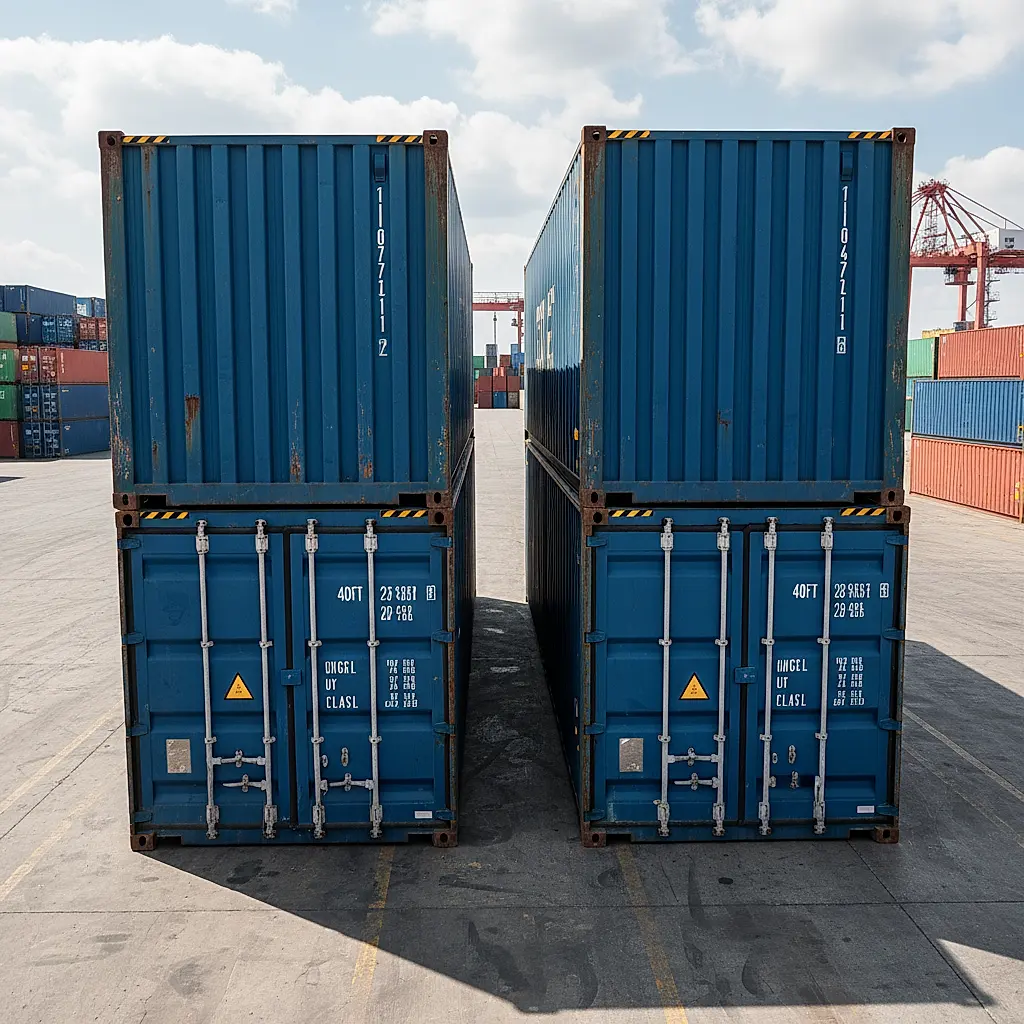
When you are browsing the inventory at a depot, the visual difference between a 40ft HC vs 40ft standard and a high cube variant might seem negligible at first glance. However, that single extra foot of vertical space is the most debated metric in the industry. For a storage buyer, it determines if a forklift can clear the header; for a home builder, it dictates whether a ceiling fan will decapitate a tall guest. Understanding the 40ft high cube container vs standard dimensions is not just about technical specs—it is about avoiding a $5,000 mistake in logistics or livability. 40ft High Cube Container vs Standard Dimensions
Table of Contents

Breaking Down 40ft High Cube Container vs Standard Dimensions
The fundamental difference between these two units lies entirely in the **shipping container exterior height**. A standard 40ft container stands at 8 feet 6 inches tall. A high cube (HC) container stands at 9 feet 6 inches tall. While their length (40') and width (8') remain identical to meet ISO 668 standards for global intermodal transport, that extra vertical foot increases the internal volume by approximately 344 cubic feet.
| Feature | 40ft Standard (GP) | 40ft High Cube (HC) |
|---|---|---|
| Exterior Height | 8' 6" (2.59m) | 9' 6" (2.90m) |
| Internal Clearance | 7' 10" (2.39m) | 8' 10" (2.70m) |
| Door Opening Height | 7' 6" (2.28m) | 8' 5" (2.56m) |
| Cubic Capacity | 2,350 cu ft | 2,694 cu ft |
| Tare Weight | ~8,000 lbs | ~8,700 lbs |
Internal Clearance 40 Foot High Cube: Why It Matters
The **internal clearance 40 foot high cube** units provide is roughly 8 feet 10 inches. In contrast, a standard unit leaves you with just 7 feet 10 inches. This difference is critical when you account for the 'gooseneck tunnel'—a recessed area in the floor at the front of the container designed to allow the unit to sit lower on a chassis. If you are planning a 40ft high cube container vs standard dimensions, this extra space is often non-negotiable. 40ft High Cube Container vs Standard Dimensions
Always measure your tallest piece of equipment before buying. A standard forklift with a collapsed mast height of 84 inches will struggle to maneuver inside a standard container once you account for the door header clearance. 40ft High Cube Container vs Standard Dimensions
Shipping Container Height for Insulation and Flooring
For residential conversions, the **shipping container height for insulation** is a dealbreaker. To meet the International Residential Code (IRC), habitable rooms generally require a 7-foot minimum ceiling height. If you add 2x4 framing for floor insulation and a drop ceiling for HVAC and spray foam, a standard 8'6" container will leave you with a cramped, sub-7-foot ceiling that feels like a crawlspace. We almost exclusively recommend the 40ft high cube container vs standard dimensions for projects like the 40ft HC vs 40ft standard. 40ft High Cube Container vs Standard Dimensions
Logistics and Transport: The High Cube Trade-off
One common concern is the **high cube container weight vs standard** and how it affects delivery. While an HC unit weighs about 700–900 lbs more than a standard unit, the real challenge is total height on the road. When loaded onto a standard flatbed or tilt-bed trailer, a high cube container can reach a total height of 13' 6" to 14' 0". 40ft High Cube Container vs Standard Dimensions
- Standard Highway Clearance: Most US interstate bridges are 14' to 16' clear, but rural routes often have older 13' 6" bridges.
- Permit Requirements: In some states, a high cube on a standard high-deck trailer may require an 'oversize' permit for height.
- Site Prep: Ensure your delivery path has no low-hanging power lines or tree branches. Refer to our shipping container exterior height for specific measurements. 40ft High Cube Container vs Standard Dimensions
Storage Utility: Pallet Stacking and Volume
For commercial buyers, the **pallet stacking capacity 40ft container** analysis often favors the high cube. If you are storing standard 48" x 40" pallets stacked two-high, a standard container often leaves only a few inches of clearance, making it nearly impossible for a forklift to place the second tier without scraping the roof. The **extra foot of height benefits** become clear here: it allows for easier loading and the potential for a third tier of smaller crates, maximizing your dollar-per-square-foot ROI.
2026 Price Reality
Expect to pay a premium of $500 to $1,200 for a high cube over a standard 40ft unit. However, considering the 15% increase in volume, the cost per cubic foot is actually lower on the high cube. 40ft High Cube Container vs Standard Dimensions

Structural Engineering and Weight Distribution Differences
When analyzing the 40ft high cube container vs standard dimensions, one must consider the metallurgical impact of that extra foot of verticality. A standard 40ft container stands at 8 feet 6 inches, while the high cube variant reaches 9 feet 6 inches. This increase in height shift the center of gravity upward, particularly when the unit is fully loaded. Engineers design the corner castings and vertical load-bearing posts to handle the increased leverage forces that occur during maritime transit where lateral swaying is constant. While the footprint of 400 square feet remains identical, the structural rigidity of a high cube is reinforced at the roof-to-header joints to ensure that the extra volume does not translate into structural bowing under extreme stacking pressure. 40ft High Cube Container vs Standard Dimensions
Weight ratings for these units often surprise first-time buyers. Despite being larger in volume, a 40ft high cube often has a slightly higher tare weight (the weight of the empty container) than its standard counterpart. Typically, a standard 40ft unit weighs approximately 8,000 lbs, whereas a high cube can weigh between 8,500 and 8,800 lbs depending on the manufacturer and the thickness of the C-channel steel used in the floor cross-members. This means that if you are operating under strict road weight limits, the high cube actually offers a slightly lower maximum payload capacity for heavy goods like granite or machinery. You are essentially trading roughly 500 to 800 pounds of weight capacity for the 344 cubic feet of extra interior air space.
Floor construction is another area where dimensions dictate utility. Both types generally utilize 1.1-inch (28mm) thick marine-grade plywood or bamboo flooring, supported by steel cross-members. However, because high cubes are frequently used for lighter, bulkier goods, they are often subjected to different wear patterns. In a standard unit, dense loads are spread low across the floor. In a high cube, the potential for top-heavy loading means that the floor must be perfectly level to prevent the unit from tilting during crane operations. Buyers should inspect the underside of high cubes specifically for 'gooseneck tunnels.' Most 40ft high cubes feature a recessed area in the front under-structure that allows the container to sit lower on a specialized chassis, ensuring it clears highway bridge height restrictions.
Finally, the ventilation systems in high cubes are positioned higher up on the side walls. This seemingly minor dimensional tweak is critical for preventing 'container sweat' or condensation. Because hot air rises, the extra foot of space in a high cube allows for a larger buffer zone between the top of the cargo and the roof. This thermal buffer helps regulate the internal temperature better than a standard unit, where cargo is often packed right up against the ceiling. For long-term storage of moisture-sensitive materials like paper, textiles, or electronics, the high cube's vertical clearance provides a natural ventilation advantage that standard containers lack. 40ft High Cube Container vs Standard Dimensions
| Feature | 40ft Standard | 40ft High Cube |
|---|---|---|
| Exterior Height | 8' 6" | 9' 6" |
| Interior Height | 7' 10" | 8' 10" |
| Door Opening Height | 7' 6" | 8' 5" |
| Total Volume (Cu. Ft.) | 2,393 | 2,694 |
Always verify the bridge clearance on your delivery route. A high cube on a standard flatbed trailer can reach a total height of 13' 6" to 14', which is the maximum limit for many interstate overpasses.
Modifications and Residential Conversion Feasibility
In the realm of container architecture and 'tiny homes,' the 40ft high cube is the undisputed industry standard. The primary reason is the requirement for insulation and infrastructure. When you add a subfloor for plumbing and a drop ceiling for electrical wiring and recessed lighting in a standard container, the 7-foot-10-inch interior height quickly shrinks to less than 7 feet. This creates a claustrophobic environment that often fails to meet local building codes for habitable ceiling heights. By starting with a high cube, you gain that extra 12 inches of vertical room, allowing for a standard 8-foot finished ceiling even after thick closed-cell spray foam insulation and flooring are installed. 40ft High Cube Container vs Standard Dimensions
From a modification standpoint, the extra foot of height in a high cube changes the physics of door and window installation. In a standard 40ft unit, installing a standard 6'8" exterior door leaves very little header space for structural reinforcement. In a high cube, you have nearly two feet of steel remaining above a standard door frame, providing ample room for a robust steel lintel to prevent the roof from sagging over the opening. This makes high cubes significantly easier and safer to modify for retail pop-ups, offices, or modular housing. The extra height also permits the installation of larger windows, which significantly improves natural light penetration in deep 40-foot structures. 40ft High Cube Container vs Standard Dimensions
HVAC considerations also favor the high cube dimensions. In a standard container, ductwork must often be exposed or run along the sides, eating into the already narrow 7-foot-8-inch interior width. In a high cube, many contractors utilize the extra vertical space to build a 'false ceiling' plenum. This allows for the installation of slim-duct mini-split systems or traditional forced-air venting without sacrificing the floor space needed for furniture or equipment. For industrial applications, such as housing server racks or large generators, this overhead space is essential for cable trays and exhaust systems that must remain separated from the primary hardware to prevent overheating.
Cost-benefit analysis for modifications usually shows that while high cubes cost 15% to 25% more on the used market, the resale value of a modified high cube is disproportionately higher. Buyers looking for workshops or storage units value the ability to install standard pallet racking with three levels of storage, whereas a standard unit often limits you to two levels. Furthermore, if you plan to install a ceiling-mounted hoist or gantry crane, the extra foot of clearance is the difference between being able to lift an engine block off a pallet or having the hook bottom out before the load is cleared. The utility of the high cube in specialized labor environments cannot be overstated. 40ft High Cube Container vs Standard Dimensions
- Residential Code Compliance: High cubes easily accommodate 8ft ceilings after insulation.
- Vertical Storage: Enables triple-stacking of standard pallets.
- Overhead Utilities: Space for HVAC ducting, electrical conduits, and fire sprinkler systems.
- Improved Aesthetics: Higher ceilings reduce the 'tunnel' feel of a 40ft long space.
- Modification Integrity: More steel 'header' space above cutouts for doors and windows.
If you are building a multi-story container home, use high cubes for the bottom floor to allow for plumbing runs in the ceiling, and standard units for the top floor to save on purchase and transport costs. 40ft High Cube Container vs Standard Dimensions
Procurement and Market Availability Trends
Understanding the availability of 40ft high cube vs standard dimensions requires a look at global shipping trends. Over the last decade, the shipping industry has shifted heavily toward high cube units for trans-Pacific routes. Because light, high-volume consumer goods (like clothing and electronics) dominate exports from Asia, carriers prefer the high cube to maximize the 'cube out' before they 'weight out.' Consequently, in many major port cities like Long Beach, Savannah, or Houston, you may actually find a higher inventory of used 40ft high cubes than standard 40ft units. This surplus can sometimes narrow the price gap between the two, making the high cube an even more attractive option for domestic buyers.
However, in inland 'depots' or smaller regional hubs, standard 40ft containers remain prevalent for heavy industrial transport. When sourcing a container, you must also consider the 'One-Trip' vs 'Cargo Worthy' vs 'Wind and Watertight' (WWT) conditions. High cubes are the primary choice for 'One-Trip' buyers (containers that are manufactured in China, loaded once, and sold upon arrival in the US) because they offer the most utility for the shipping cost. If you are looking for a pristine, dent-free unit for a high-end office conversion, you will almost exclusively be looking at 40ft high cubes. Standard units in 'One-Trip' condition are rarer and often require a custom order or a longer wait time from the supplier. 40ft High Cube Container vs Standard Dimensions
The final dimension to consider is the door configuration. While both standard and high cube units typically feature the traditional double swing doors on one end, high cubes are more frequently available in 'Double Door' (tunnel) configurations. This means doors are located on both 8-foot ends. The extra height combined with double-end access makes the high cube a superior choice for drive-through storage or for situations where you need to access goods from both ends of a 40-foot run without unloading the entire container. When you factor in the dimensional advantages for loading and unloading, the market's lean toward high cubes becomes a self-fulfilling prophecy, ensuring they remain the standard-bearer for the next generation of modular storage solutions.
Frequently Asked Questions
Based on our 15 years in the field, here are the most common questions regarding the **40ft HC vs 40ft standard** debate. 40ft High Cube Container vs Standard Dimensions