
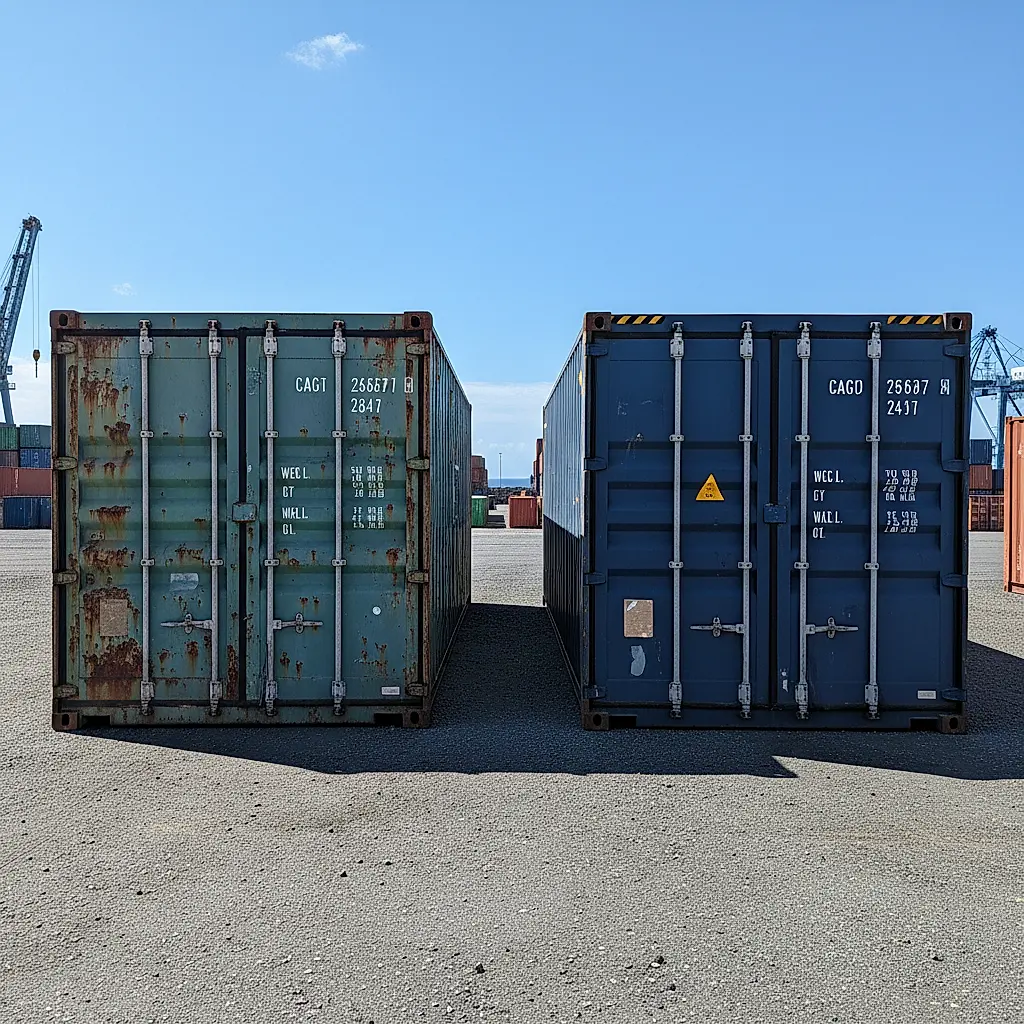
When you are browsing the secondary market for steel boxes, the industry jargon can feel like a barrier to a simple purchase. Most buyers find themselves stuck choosing between a shipping container wind and water tight vs cargo worthy unit. While they might look identical from twenty feet away, the distinction involves more than just a few patches of rust. Choosing the wrong grade can mean the difference between a container that is legal for ocean freight and one that is restricted to ground-level storage on your farm or job site.
Table of Contents

shipping container wind and water tight vs cargo worthy: WWT Container Meaning: The Storage Standard
The weatherproof storage containers is straightforward: it is a retired fleet unit that no longer holds a valid marine survey but is guaranteed to be dry. To qualify as Wind and Water Tight, the doors must seal properly to prevent moisture ingress, and there should be no daylight visible through the roof or walls when you're standing inside with the doors closed. These are the workhorses of the weatherproof storage containers market.
In 2026, a WWT unit typically shows significant surface rust, dings, and previous patches. However, for a homeowner or business needing to protect inventory from the elements, a ISO shipping container condition in WWT condition is often the most cost-effective solution.
Cargo Worthy Container Standards: Ready for the Sea
If WWT is about keeping rain out, Cargo Worthy (CWO) is about structural integrity. The ISO shipping container condition dictate that the unit must be capable of being stacked several units high and withstand the stresses of a crane lift while fully loaded. To be CWO, the container must meet the original ISO shipping container condition specifications and possess a valid CSC (Convention for Safe Containers) plate.
A container can be Cargo Worthy even if it looks aesthetically worse than a WWT unit. Grading focuses on the frame, corner castings, and floor cross-members, not the cosmetic quality of the paint.
CWO vs WWT Price Difference in 2026
The price gap between these two grades generally ranges from $200 to $600 per unit. This premium for CWO units covers the cost of the inspection and the assurance that the steel frame hasn't been compromised. For those ISO shipping container condition for simple storage, the CWO vs WWT price difference may not be worth the extra spend unless you plan to move the container frequently while loaded.
| Feature | WWT (Wind & Water Tight) | CWO (Cargo Worthy) |
|---|---|---|
| Primary Use | Stationary Storage | International Shipping / Stacking |
| Structural Integrity | Not certified for heavy loads | Certified for ISO stacking/transit |
| Watertight Seal | Guaranteed | Guaranteed |
| CSC Plate | Expired/Invalid | Valid / Recertifiable |
| 2026 Est. Price (20ft) | $1,800 - $2,200 | $2,100 - $2,600 |
Used Container Grades Explained: Choosing Your Unit
When evaluating a weatherproof storage containers decision, consider your long-term plans. If you are building a structure, local building officials often require a Cargo Worthy grade or higher to ensure the frame meets ISO shipping container condition. However, if you are simply looking for ISO shipping container condition, a WWT unit is often plenty.
- WWT: Best for dry storage, sheds, and workshops.
- Cargo Worthy: Required for export, shipping, and multi-story modular builds.
- One-Trip: The 'new' standard for high-end offices and homes.
- As-Is: High risk; may have holes or floor damage.

Technical Nuances: Stacking and Shipping
A common question is whether a WWT container is stackable. While the corner posts of most WWT containers can technically support weight, they lack the ISO shipping container condition to prove it. If you are stacking containers for a WWT container meaning, sticking to CWO or New units is a safety non-negotiable. Shipping container
Pro Tip for Buyers
Always check the gaskets. A WWT container is only as good as the rubber seals on the doors. Even a structurally perfect CWO unit will fail to protect your goods if the gaskets are dry-rotted or missing. Shipping container
Structural Integrity and the CSC Plate: The Regulatory Divide
While both WWT (Wind and Water Tight) and CWO (Cargo Worthy) units are used containers with a history of ocean transit, the primary legal distinction lies in the validity of the Convention for Safe Containers (CSC) plate. A Cargo Worthy container is structurally sound enough to pass a formal inspection by a certified surveyor, allowing it to be re-certified for international transport. This certification ensures the corner castings, bottom rails, and top headers can withstand the extreme vertical pressure of being stacked nine-high on a vessel. In contrast, a WWT container is typically sold 'as-is' regarding its structural certification; while it remains weather-proof, it lacks the formal documentation required to be hoisted onto a ship.
For buyers in the US market, this distinction is critical if there is even a remote possibility of relocation. If you plan to move your loaded container across state lines via rail or overseas via cargo ship, the CWO grade is a non-negotiable requirement. A WWT unit is effectively 'retired' from the logistics loop. While it will keep your lawnmowers or inventory dry in a backyard, it is legally prohibited from entering the intermodal supply chain once its CSC plate expires without a successful CWO re-certification.
- CSC Plate Status: CWO units can be re-certified; WWT units generally have expired plates.
- Stacking Capacity: CWO ensures the frame can handle 190,000+ lbs of overhead weight.
- Door Hardware: CWO requires functioning locking bars and cams that meet ISO tolerances.
- Floor Condition: CWO restricts the depth of gouges or delamination in the marine plywood.
- Structural Straightness: WWT allows for greater bowing in the side panels compared to CWO.
Pro Tip: If you are purchasing a container for a modular home or a building project, your local building inspector may require a CWO certification to prove the structural load-bearing capacity of the steel frame, even if the unit will never go back to sea.
Interior and Floor Condition Standards for Used Units
The internal condition of a container is often overlooked by buyers focusing solely on the exterior rust. In the hierarchy of grades, CWO units must meet stricter interior criteria to ensure that forklift traffic and palletized goods don't snag or break through the floorboards. The floor of a CWO container is composed of 1.1-inch thick marine-grade plywood, and standards dictate that no light can be visible from the underside. While WWT units also prevent light from entering, they may have more significant 'delamination'—where the layers of the plywood begin to separate—or deeper oil stains from previous industrial cargo.
Chemical odors and interior residue are another factor. Because CWO units are vetted for immediate return to service, they are less likely to contain pungent odors or hazardous spills that could contaminate new cargo. For storage of textiles, sensitive electronics, or documents, the slight price premium for a CWO unit often pays for itself in the cleanliness of the interior environment. WWT units are more likely to show 'transferable' stains, meaning old grease or residue could potentially rub off on your stored items.
| Feature | WWT Standard | CWO Standard | |
|---|---|---|---|
| Floor Plywood | Surface gouges allowed, no holes. | Structural sound, minimal delamination. | Limited repairs allowed per IICL. |
| Understructure | Rust permitted, crossmembers must be present. | Crossmembers must be straight and secure. | |
| Interior Odor | Possible residual odors from prior cargo. | Generally clean and neutral. | |
| Patching | Welded patches or sealant allowed. | Patches must meet ISO welding standards. |
Avoid units that show signs of 'bubbling' on the floorboards. This often indicates moisture trapped between the steel understructure and the wood, which can lead to dry rot or floor failure under heavy loads. Shipping container
Maintenance and Longevity: The ROI of Grade Selection
When calculating the long-term value of your purchase, consider the lifecycle of the steel. Most WWT containers have been in service for 12 to 15 years, while CWO units are often on the younger end of that spectrum or have been better maintained by the shipping line. The presence of surface rust (oxidation) is common in both grades, but CWO units generally have less 'scale'—the thick, flaking rust that eats into the Corten steel. Investing in a CWO unit means you are starting with a base that has less structural degradation, which translates to fewer repairs over a 10-year storage lifespan. Shipping container
For those in high-corrosion environments, such as coastal regions or areas with high humidity, the CWO grade provides a better canvas for preventative maintenance. Because the seals and gaskets are usually in better condition, you spend less on aftermarket weatherstripping. If you intend to paint the container to match a residential or commercial property, the smoother side panels of a CWO unit require less prep work (grinding and priming) than a heavily dented and scaled WWT unit. This reduces labor costs significantly if you are hiring out the refurbishment. Shipping container
- 1Inspect the Gaskets: CWO units typically have supple rubber seals that prevent moisture ingress.
- 2Check for Daylight: Step inside and close the doors; zero light should enter in either grade.
- 3Evaluate the Roof: Ensure there are no standing water pools, which lead to pinhole leaks in WWT units.
- 4Check Door Operation: CWO units must be easy to open/close for dock workers; WWT may require a pry bar.
- 5Assess Surface Rust: Use a wire brush to see if rust is superficial or if it has compromised the steel thickness.
Regardless of the grade, always place your container on a level foundation of gravel, railroad ties, or concrete pads. This prevents the frame from twisting, which is the leading cause of door alignment issues in both WWT and CWO containers. Shipping container
Frequently Asked Questions
If you are ready to compare inventory for your project, our team can pull matching units from our nationwide depots. Whether you need the structural security of a CWO unit for export or the budget-friendly dry storage of a WWT box, Outback Shipping Containers ensures your delivery is handled with professional precision. Shipping container