
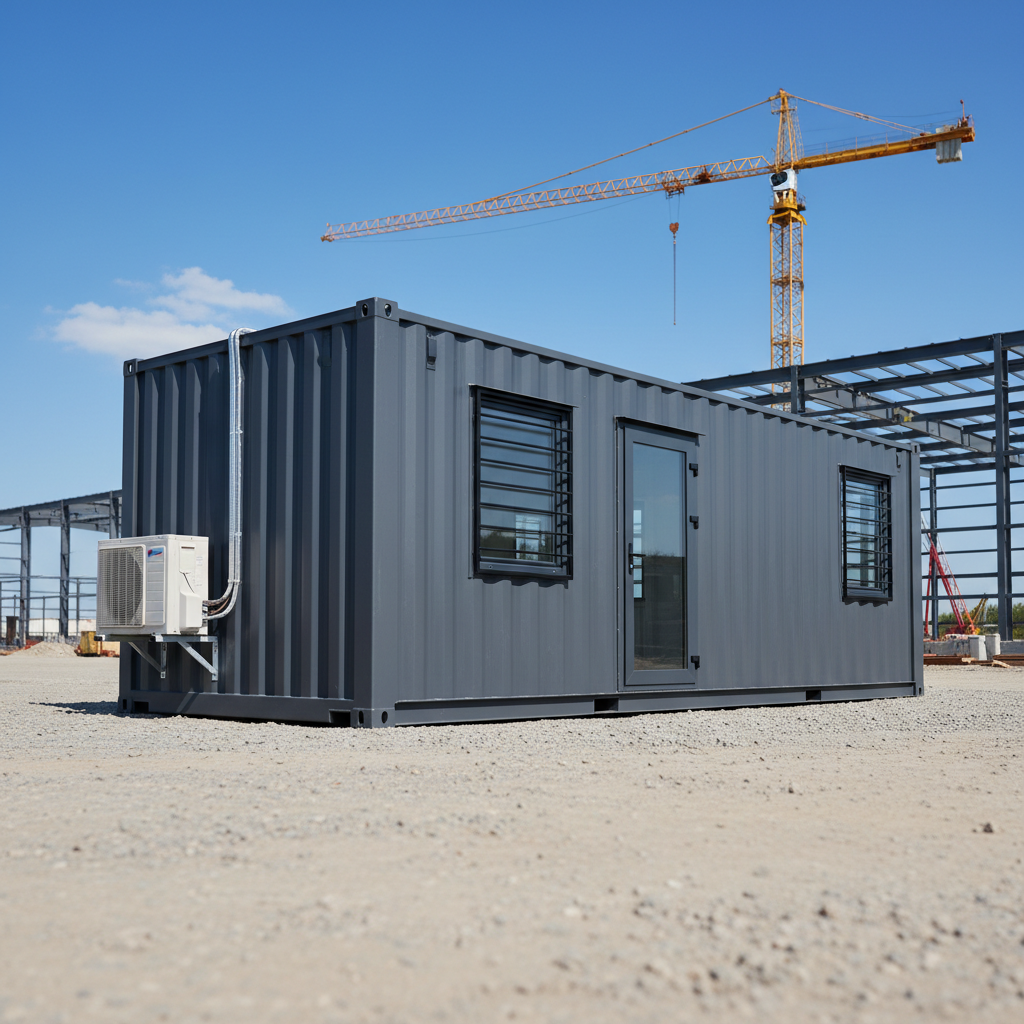
For US site supervisors and project managers, the 'office trailer' is often a point of frustration—drafty, prone to water damage, and easily broken into. This project cycle, we're seeing a decisive shift toward the custom prefab container office for job sites price bracket, where buyers prioritize the durability of Corten steel over the low entry cost of wood-frame modular units. As of July 2026, the market for heavy duty steel prefab offices has matured, offering turnkey solutions that arrive pre-wired and ready for personnel within hours of delivery.
Table of Contents
- 1custom prefab container office for job sites price: 2026 Price Ranges for Prefab Container Offices
- 2Essential Features of Pre-Wired Site Office Containers
- 3Comparing Insulated Job Site Container Units
- 4Logistics: Ground Level Office Container Delivery
- 5Regional Price Disparity: Freight and Fabrication Hubs
- 6High-Efficiency HVAC and Electric: The Long-Term ROI
- 7Decoding Modification Specs: Framing and Flooring Costs
- 8Frequently Asked Questions
- 9Making the Right Investment for Your Fleet
- 10Explore Related Products & Guides

custom prefab container office for job sites price: 2026 Price Ranges for Prefab Container Offices

The custom prefab container office for job sites price varies significantly based on insulation type, electrical complexity, and the base unit's condition. While a used 20ft container might be the starting point for a DIY project, most commercial buyers prefer a 'One-Trip' or new shipping container to ensure structural integrity and professional aesthetics for a customized mobile site headquarters.
| Office Type | Base Unit Size | Price Range (USD) | Key Features |
|---|---|---|---|
| Basic Shell Office | 20ft Standard | $12,500 - $16,000 | Batten insulation, basic electric, vinyl floor |
| Standard Site HQ | 20ft New | $18,000 - $24,500 | Spray foam, 12k BTU HVAC, personnel door, 2 windows |
| Executive Operations | 40ft High Cube | $32,000 - $48,000 | Separate restroom/kitchenette, dual HVAC zones |
| Combo Unit | 40ft Standard | $28,000 - $38,000 | 15ft Office / 25ft Storage partition with roll-up door |
Essential Features of Pre-Wired Site Office Containers
When evaluating an industrial portable office price, the bill of materials reveals the true value. A standard Converted 40ft Shipping Container Office should adhere to specific safety and utility standards to be useful on a modern job site. In 2026, the baseline for a 'professional' unit has shifted upward to include higher-spec electrical components that won't trip breakers when running high-draw monitors and AC units simultaneously.
- Electrical: 100-amp load center, surface-mount EMT conduit, and LED shop lights.
- Climate Control: Through-wall AC/Heating units (typically 8,000 to 12,000 BTU).
- Wall Surfaces: FRP (Fiber-Reinforced Plastic) or magnetic whiteboards for easy cleaning and plan mounting.
- Security: Steel personnel doors with deadbolts and window security bars are standard requirements.
Check your local AHJ (Authority Having Jurisdiction). While many states classify container offices as temporary structures, others require them to meet the International Building Code (IBC) even for short-term projects. Always ask your supplier for a stamped plan if your local permit office is strict.
Comparing Insulated Job Site Container Units
Don't overlook the R-value. Many low-bid prefab offices use thin fiberglass battens that settle over time, leading to massive heat gain in the summer. For a high-performance 20ft job site container office layout, we recommend closed-cell spray foam insulation. Not only does it provide a superior thermal barrier, but it also increases the overall rigidity of the unit and acts as a vapor barrier to prevent 'container rain' (internal condensation).
For those operating in extreme climates, such as the Southwest or Alaska, a 40ft High Cube base is often preferred. The extra foot of vertical space in 40ft High Cube containers allows for thicker ceiling insulation without making the space feel cramped, ensuring the unit remains OSHA compliant for worker comfort.
Logistics: Ground Level Office Container Delivery
One of the primary benefits of steel office units is the ease of ground level office container delivery. Unlike modular trailers that require expensive stairs and skirting, container offices sit directly on a level pad or dunnage. This eliminates the 'bouncy' feel of trailer suspension and makes the office more accessible to staff.
- 1Surface Prep: Ensure a level surface of gravel, concrete, or asphalt.
- 2Clearance: You need at least 60-100 feet of straight-line clearance for a tilt-bed truck to drop a unit.
- 3Orientation: Decide which way the office door should face before the driver arrives; spinning a container once it is off the truck requires heavy machinery.
For more on preparing your location, refer to our Ultimate Shipping Container Site Prep Checklist or see our Delivery Cost Per Mile Guide.
Regional Price Disparity: Freight and Fabrication Hubs
The final invoice for a custom prefab office is heavily dictated by the proximity of your job site to major intermodal hubs like Houston, Newark, or Long Beach. In these areas, the raw pool of CWO (Cargo Worthy) 20ft and 40ft containers is larger, keeping base costs lower. Conversely, if you are ordering a prefab unit for a remote site in the Dakotas or the Appalachian region, expect to pay a premium of 15% to 25% just for the empty shell before fabrication even begins. Mobile office suppliers often operate out of centralized yards, meaning the further you are from the yard, the higher the deadhead haulage fees.
Labor rates for master welders and certified electricians also fluctuate by state. A prefab container office built in a high-overhead state like California or New York will naturally command a higher MSRP than a unit built in the Midwest. When budgeting, always ask for a line-item breakdown that separates the 'container shell cost' from the 'fabrication labor.' This allows you to see if the price hike is due to actual material upgrades or simply the logistics of the manufacturer's location.
| Regional Hub | Base Shell Surcharge | Average Delivery Fee (50-mile radius) | Labor Intensity Rating |
|---|---|---|---|
| Gulf Coast (TX/LA) | Low | $350 - $600 | Moderate |
| Northeast Corridor | High | $700 - $1,100 | High |
| Mountain West | Market Dependent | $850 - $1,500+ | Moderate |
| West Coast Ports | Medium | $400 - $750 | High |
To save significantly on long-term costs, choose a yard that uses 'One-Trip' containers rather than used 'Wind and Watertight' (WWT) units. While the initial investment is $1,800–$2,500 higher, the lack of floor delamination and rust will double the office's service life.
High-Efficiency HVAC and Electric: The Long-Term ROI
Standard prefab offices often ship with a generic through-the-wall AC unit. While these are budget-friendly, they are notorious for thermal leakage and security vulnerabilities. Upgrading to a Mini-Split HVAC system typically adds $2,500 to $4,000 to the total price, but it pays for itself through reduced energy consumption and quieter operation. On a loud construction site, a quiet interior workspace is essential for project managers handling sensitive calls or coordination meetings.
Electrical packages are another area where pricing varies wildly based on complexity. For a basic job site office, a 100-amp load center with surface-mounted EMT conduit is standard. However, if your team is running high-demand tech stacks, multiple monitors, and plotters, you may require a data-integrated package. These packages include Cat6 wiring, recessed lighting to prevent head-strikes in low-clearance 8'6" standard containers, and specialized exterior hookups for rapid deployment.
- Mini-Split HVAC Upgrade: Adds $3,200 avg. to base cost but improves R-value retention.
- Spray Foam Insulation: Essential for cost savings in extreme climates; reduces heating cycles by 40%.
- Exterior Security Bars: $1,200 per window set; prevents theft of expensive office technology.
- Smart Thermostats & Timers: $450 integration; ensures HVAC doesn't run during off-hours.
- LED Flat Panel Lighting: $800 upgrade over fluorescent; reduces heat load and eye strain.
Customization Tiers: From Shell to Luxury
Most buyers fall into the 'Tier 2' category, which balances cost and comfort. A Tier 1 unit is essentially a shed with a desk—plywood walls and basic lighting. Tier 2 introduces FRP (Fiberglass Reinforced Plastic) wall panels or finished birch plywood, commercial-grade vinyl flooring, and standard insulation. Tier 3 includes luxury finishes like vinyl plank flooring, drywalled interiors, and partitioned restrooms. Choosing the right tier depends entirely on whether the unit is meant for a foreman's field office or a high-end client presentation space.
Always verify that your prefab office electrical work meets NEC (National Electrical Code) standards. Some low-cost manufacturers skip certifications, which can lead to your job site being shut down by a local fire marshal or building inspector.
Decoding Modification Specs: Framing and Flooring Costs
The structural integrity of a custom container office is compromised every time a hole is cut for a window or door. To maintain the 'C-Channel' strength, professional fabricators must weld-in steel tube frames around every opening. Cheap prefab units often shortcut this by using wood studs for window framing, which will eventually sag or leak under the stress of transit. Professional steel-framed windows add roughly $800 to $1,400 per opening to the price guide but are mandatory for units that will be moved multiple times between different project locations.
Flooring is the most abused surface on a job site. While the original 1-1/8 inch marine-grade plywood subfloor is durable, it is toxic due to the pesticides used for sea-transit. A high-quality prefab office will always include a moisture barrier and an overlay. Commercial-grade Coin Rubber or Luxury Vinyl Tile (LVT) are the industry standards. Budgeting for a 'ruggedized' floor—meaning one that can withstand mud, grit, and composite-toed boots—adds roughly $1,200 to $2,500 to a 40ft unit but prevents the structural subfloor from rotting over a 10-year period.
- 1Consult site plans to determine if a 20ft (160 sq ft) or 40ft (320 sq ft) footprint is required.
- 2Confirm the R-value of the insulation based on your local climate zone (ASTM standards).
- 3Select an exterior paint coating (Industrial Enamel vs. Polyurethane) to prevent corrosion.
- 4Internal Layout: Decide if a restroom or kitchenette is required, as this necessitates plumbing stub-outs.
- 5Verify shipping requirements: Will you need a tilt-bed trailer or a crane for placement?
Watch out for 'Bottom-Tier' units using EPS foam board instead of closed-cell spray foam. In humid environments, EPS can trap moisture against the steel wall, causing invisible 'rust-through' from the inside out within 3 to 5 years.
Frequently Asked Questions
Common questions regarding the procurement and price of job site offices.
Making the Right Investment for Your Fleet
While the custom prefab container office for job sites price may be higher upfront than a rental trailer, the long-term ROI is found in resale value and durability. A steel container office can be moved 50 times over a decade and still look pristine, whereas wood trailers often begin to show structural fatigue after just three or four relocations. If your project demands a secure, OSHA compliant container office, going with a steel prefab is the standard operational choice for 2026.
If you're ready to compare inventory for your project, our team can pull matching units from our nationwide depots and provide a firm quote including freight. Whether you need a standard Container Home Office Main or a fully custom multi-unit headquarters, we're here to help you build it.