
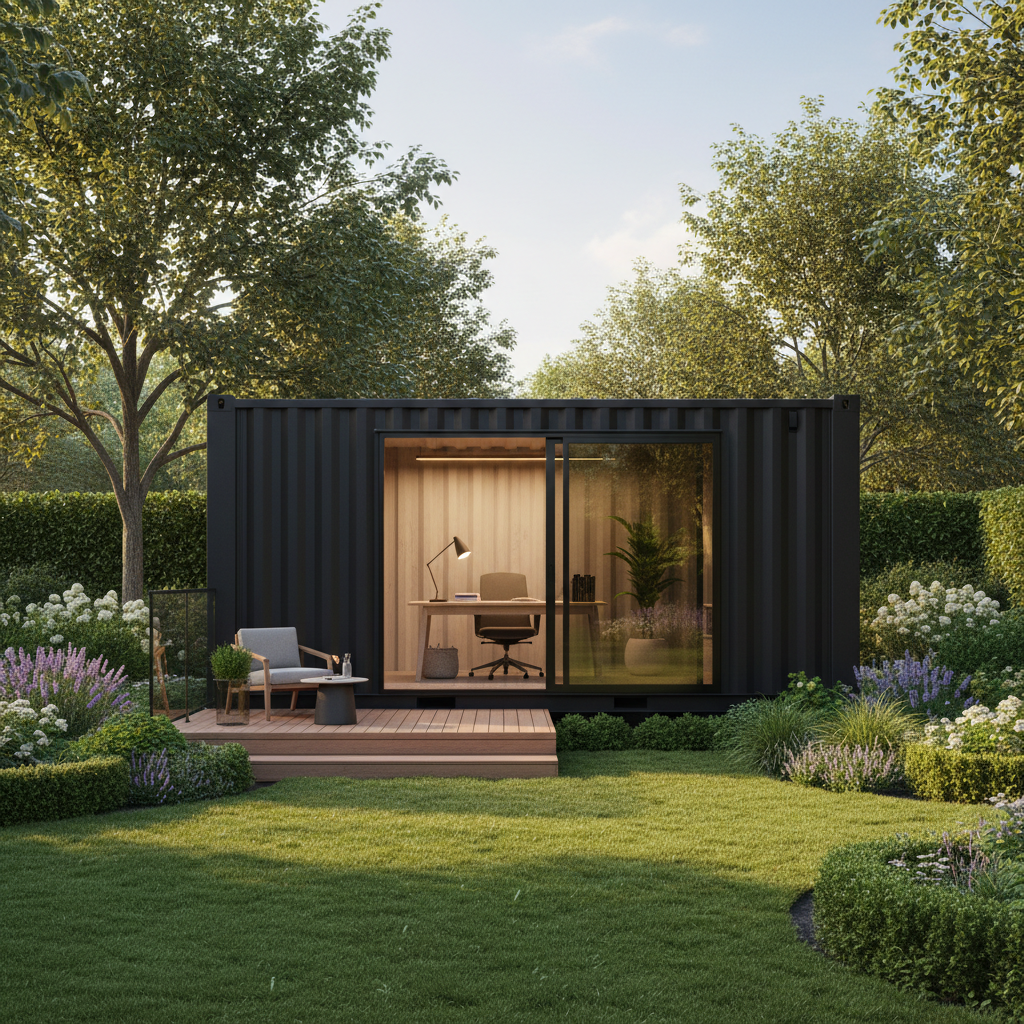
For the average US professional in 2026, the 'work from home' dream has shifted from the kitchen table to the backyard. A backyard container office cost 2026 reflects a market that has matured, moving away from experimental DIY builds toward professional-grade, high-performance detached workspaces. While a basic steel box might seem affordable, a fully conditioned, permit-ready office requires a clear understanding of site prep, insulation, and local zoning. If you're weighing the choice between a wood-frame shed and a Corten steel workspace, the decision usually comes down to durability, speed of deployment, and the industrial-modern aesthetic that only an ISO-standard container can provide.
Table of Contents
- 1backyard container office cost 2026: 2026 Pricing Breakdown: Shells vs. Fully Finished Units
- 2Hard Costs: From Delivery to Foundation
- 3Is a Shipping Container Office Cheaper Than a Wood Shed?
- 4Selecting Your Base: 20ft vs. 40ft Models
- 5Permitting and Compliance Strategy for 2026 Zoning Laws
- 6The 2026 Interior Specification Matrix
- 7Sustainability and Long-Term Maintenance Costs
- 8Frequently Asked Questions
- 9Finalizing Your 2026 Backyard Project

backyard container office cost 2026: 2026 Pricing Breakdown: Shells vs. Fully Finished Units
The wide range in shipping container office pricing is driven primarily by the level of finish and the grade of the base unit. A one-trip container is the gold standard for offices because the steel is pristine, free of dents, and hasn't spent a decade exposed to salt air. In contrast, using used containers can save upfront capital but often requires more bodywork and specialized primers to ensure a professional finish.
| Office Type | Base Unit Size | Estimated Cost (2026) | Key Features |
|---|---|---|---|
| DIY Shell (One-Trip) | 20ft Standard | $4,500 – $6,200 | Raw steel, no windows, delivery not included |
| Basic Finished Office | 20ft Standard | $18,000 – $28,000 | Insulation, LVP flooring, basic electric, 1 window |
| Executive Prefab Pod | 20ft High Cube | $35,000 – $55,000 | Glass wall, HVAC, custom cabinetry, recessed lighting |
| Multi-Zone Workspace | 40ft High Cube | $55,000 – $85,000 | Office + Storage split, bathroom, kitchenette |
Hard Costs: From Delivery to Foundation
Beyond the box itself, several 'invisible' costs will impact your backyard container office cost 2026 budget. Shipping container transport options are a major factor; a tilt-bed trailer delivery for a 20ft unit typically starts at $300–$600 for local drops but can exceed $1,500 if crane assistance is required to lift the unit over a fence or onto a tight pad.
- Foundation (Gravel or Concrete Piers): $1,200 – $3,500. Steel containers require a level, stable surface to prevent door binding.
- Electrical Hookup: $1,500 – $4,000. Includes trenching from the main house panel and a sub-panel installation.
- Permit Fees: $500 – $2,500. Depending on your local AHJ (Authority Having Jurisdiction), you may need a building permit for an Accessory Dwelling Unit (ADU).
- Insulation Costs: $2,500 – $4,500. We recommend closed-cell spray foam to prevent condensation on the interior steel walls.
Never skip the insulation. A steel box in the sun can reach interior temperatures of 120°F without proper thermal breaks. Spray foam is the only way to ensure 2026-level energy efficiency and prevent the 'sweating' effect typical of poorly ventilated metal structures.
Is a Shipping Container Office Cheaper Than a Wood Shed?
A common question is whether shipping container shed office prices beat out traditional stick-built or Tuff-Shed style structures. The answer depends on longevity. While a basic wooden shed might have a lower entry price of $8,000, it is susceptible to rot, termites, and fire. A container office is inherently anti-vandal, fire-resistant, and built from Corten steel designed to withstand ocean crossings. When you factor in the shipping container grade price comparison, the ROI of a steel unit often wins out over a 10-year horizon due to lower maintenance.

Selecting Your Base: 20ft vs. 40ft Models
For most backyard applications, the 20ft container is the industry standard. It fits within most residential setbacks and offers enough space for a large desk, shelving, and a small seating area. However, if your business requires a client meeting space or a dedicated storage zone, a 40ft high cube provides 9'6" ceilings and double the square footage. For specialized needs, some buyers even opt for a 21ft office & storage 50/50 split, which allows for a clean workspace on one side and heavy equipment storage on the other.
Essential Modifications for 2026
- 1HVAC: A mini-split heat pump is essential for both heating and cooling.
- 2Windows: Use dual-pane, tempered glass for sound dampening and thermal regulation.
- 3Flooring: Luxury Vinyl Plank (LVP) is preferred for its durability over the original marine-grade plywood floors.
- 4Connectivity: Cat6 wiring and a dedicated Wi-Fi bridge to the main house.
Permitting and Compliance Strategy for 2026 Zoning Laws
Navigating the legal landscape for backyard container offices has become more complex as of 2026. While many jurisdictions now recognize Accessory Dwelling Units (ADUs), shipping containers often fall into a 'gray area' between temporary structures and permanent foundations. In 2026, most US municipalities require a site plan that specifically addresses structural integrity and wind load ratings, especially for containers which can behave like sails if not properly anchored. Budgeting for these soft costs is essential; expect to allocate $1,500 to $4,500 just for professional engineering stamps and municipal filing fees.
A significant shift in 2026 is the widespread adoption of strict energy codes (IECC updates). A bare metal box will not pass inspection in most states without high-performance insulation. Most builders are now utilizing closed-cell spray foam or rigid polyisocyanurate boards to achieve R-value targets without sacrificing precious interior square footage. When calculating your total backyard container office cost 2026, you must factor in these compliance-driven insulation costs, which typically range from $2,200 for a 20ft unit to over $5,000 for a 40ft High Cube.
- Zoning Verification: Ensure your property is zoned for detached accessory structures.
- Setback Requirements: Most codes require a minimum of 5 to 10 feet from property lines.
- Electrical Sub-panels: Permits usually require a licensed electrician to pull a separate permit for the link to your main house panel.
- Egress Requirements: If the office doubles as a guest room, specific window dimensions are mandatory for fire safety.
Never assume a container is 'portable' enough to bypass permits. In 2026, utilities connections (electricity and HVAC) automatically trigger the need for a building permit in 90% of US residential zones.
The 2026 Interior Specification Matrix
The interior finish significantly dictates the final ROI of your unit. In 2026, buyers are moving away from 'industrial raw' looks toward high-end residential finishes that mimic traditional office buildings. This shift involves moving from simple plywood cladding to gypsum board or architectural acoustic panels. Acoustic management is particularly critical in metal containers; without sound-dampening materials, the 'echo chamber' effect makes professional video calls difficult. Standard 2026 fit-outs now include recessed LED lighting, built-in desks, and luxury vinyl plank (LVP) flooring as baseline expectations.
| Feature Level | Typical Materials | Estimated Cost (20ft Unit) | Target Use Case |
|---|---|---|---|
| Essential | Plywood walls, exposed conduit, LVP flooring | $8,000 - $12,000 | Workshop, storage, casual hobby space |
| Professional | Drywall, hidden wiring, mini-split HVAC | $15,000 - $22,000 | Full-time remote work, consulting |
| Executive | Glass slider doors, acoustic panels, smart home tech | $25,000 - $35,000+ | Client-facing studio, high-end ADU |
Climate control remains the highest recurring operational cost. For 2026, the industry standard has shifted toward high-efficiency heat pump mini-splits with SEER2 ratings of 20 or higher. While these units have a higher upfront cost (roughly $1,800 to $3,200 installed), they are essential for the narrow thermal envelope of a steel container. Additionally, smart thermostats are now being integrated to prevent condensation by maintaining a consistent internal temperature, protecting your electronics from the humidity spikes common in metal structures.
Opt for 'High Cube' containers (9'6" tall) instead of standard containers (8'6"). The extra foot of vertical space is necessary once you install floor insulation and ceiling lighting, preventing the office from feeling cramped.
Sustainability and Long-Term Maintenance Costs
The 2026 market places a premium on sustainable retrofitting. 'Upcycled' is no longer just a buzzword; it’s a cost-saving measure. However, the lifespan of a backyard container office depends entirely on corrosion management. A primary cost concern in 2026 is the application of ceramic-infused exterior paints or specialized elastomeric coatings. These coatings reflect up to 90% of solar radiation, drastically lowering cooling costs while providing a rust-inhibiting barrier that can extend the unit's life to 25+ years.
Maintenance schedules for 2026 units should include an annual inspection of the roof seams and the integrity of the door gaskets. Because containers are rigid, any shifting in the foundation—whether it's a gravel pad or concrete piers—can lead to door misalignment. Budgeting approximately $200-$500 per year for minor paint touch-ups and seal checks will protect the five-figure investment you've made in the shell and interior finishes. Owners who neglect the exterior metal skin often see a sharp decline in resale value within just five to seven years.
- 1Year 1: Check foundation levelness after the first freeze/thaw cycle.
- 2Year 3: Re-seal all window and door penetrations with high-grade silicone.
- 3Year 5: Full exterior wash and inspection for 'spider-web' rust spots.
- 4Year 10: Potential roof coating refresh depending on UV exposure levels.
Integrating solar panels on a 20ft container roof can offset 60-80% of office power needs in 2026, though this adds roughly $4,000 to $7,000 to the initial project cost.
Frequently Asked Questions
How much does a 20ft backyard container office cost?
In 2026, a 20ft backyard office ranges from $18,000 for a basic DIY-finished unit to $55,000 for a luxury, turn-key model with high-end glazing and HVAC.
Do I need a permit for a container office in my backyard?
Generally, yes. Most US municipalities classify these as Accessory Dwelling Units (ADUs) or accessory structures. You will likely need to meet local setback requirements and electrical codes. Check our 2026 permit guide for details.
Is a shipping container office cheaper than a wood shed?
A finished container office is usually 15-20% more expensive than a basic wood shed but offers significantly higher durability, security, and a longer lifespan with less maintenance.
What is the average ROI of a container home office?
Property data shows that a permit-compliant detached office can recoup 70-85% of its value upon home sale, especially in markets where remote work is prevalent.
Does a backyard office increase property value in 2026?
Yes, adding usable, climate-controlled square footage to a property consistently increases appraised value, provided the unit is installed on a permanent foundation and follows local zoning.
How long does installation take?
Once the unit is delivered, final hookups for electrical and foundation leveling usually take 1-3 days, making it much faster than traditional construction.
Finalizing Your 2026 Backyard Project
Investing in a backyard workspace is more than just buying a box; it's about creating a productive environment that survives the elements. Whether you are looking for a refurbished office unit or planning a custom build from scratch, the keys to success are site preparation and quality insulation. If you're ready to compare inventory for your project, our team can pull matching units from our nationwide depots and help you navigate the delivery logistics for your specific site.