
If you have ever left a cold soda can on a porch in August, you have seen a shipping container’s biggest weakness in action. Steel is an exceptional thermal conductor. When warm, humid air meets a cold steel surface, the air loses its ability to hold moisture, and water droplets form instantly. In a residential setting, this isn't just a puddle on a coaster; it is 'interior rain' that can rot your framing, ruin your drywall, and cause mold growth within your wall cavities. Effectively preventing condensation in shipping container homes is not just about comfort—it is the single most important technical requirement for structural longevity.
Table of Contents
- 1preventing condensation in shipping container homes: Understanding the 'Sweat' Factor in Steel Buildings
- 2The Gold Standard: Closed Cell Spray Foam
- 3Strategic Framing and Vapor Barriers
- 4Container Home Ventilation Systems
- 5Exterior Solutions: Coatings and Cladding
- 6Thermal Bridging and the Critical Role of Subfloor Insulation
- 7Active Dehumidification and ERV Integration
- 8Interior Finishing: Avoiding the 'Moisture Sandwich'
- 9Frequently Asked Questions
- 10Final Thoughts on Moisture Mitigation
- 11Explore Related Products & Guides

preventing condensation in shipping container homes: Understanding the 'Sweat' Factor in Steel Buildings
Before you look for a shipping container vapor barrier, you must understand the physics of the shell. A container is a giant airtight box made of Corten steel. Unlike traditional wood-framed houses, there is zero breathability. If you do not manage the temperature differential between the exterior steel and the interior living space, the container will 'breathe' moisture onto your insulation. This is why shipping container vapor barrier requires a different approach than a standard stick-built home.
The Gold Standard: Closed Cell Spray Foam
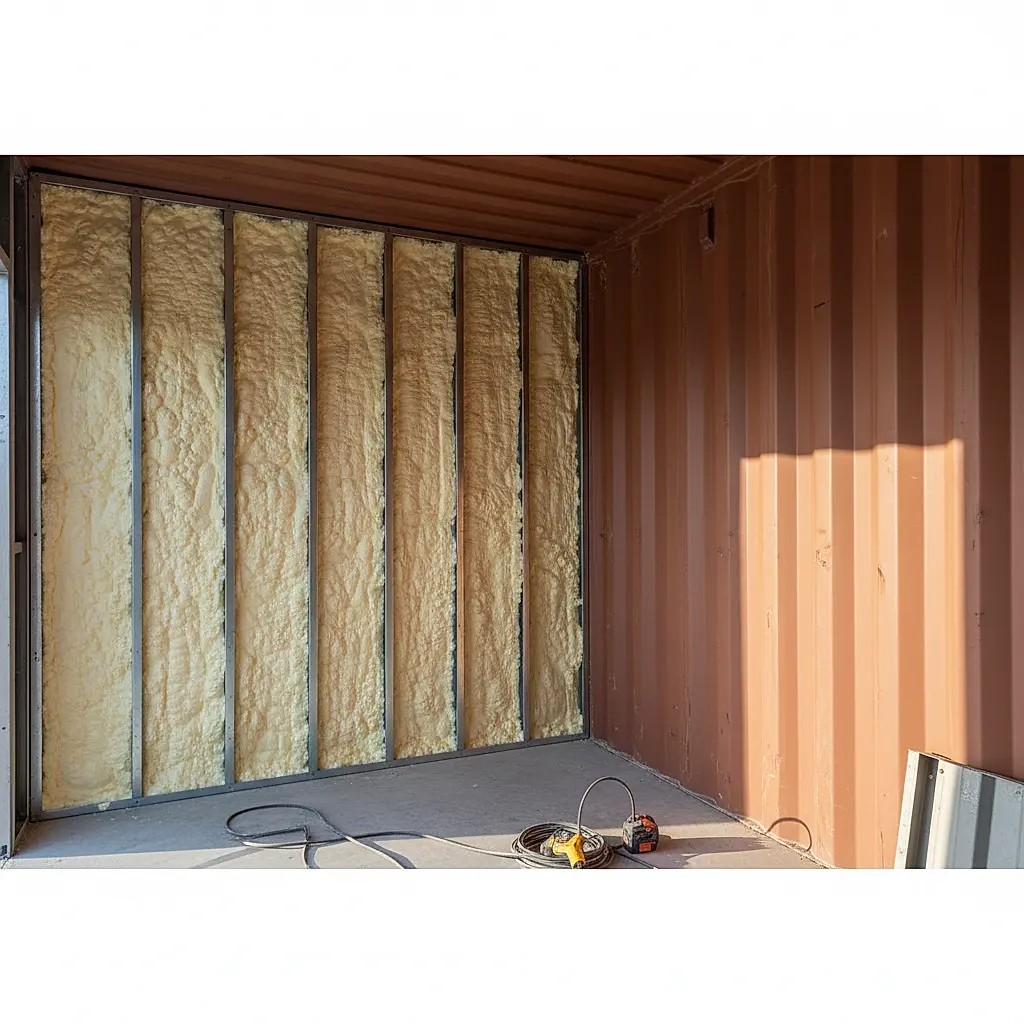
In the shipping container industry, **closed cell spray foam** is widely considered the superior method for moisture mitigation. Unlike fiberglass batts or mineral wool, closed-cell foam adheres directly to the steel corrugations. This eliminates the air gap where condensation usually forms. By sealing the steel from the inside air, the foam acts as both high-R-value insulation and a seamless shipping container vapor barrier.
- Eliminates air pockets between insulation and steel.
- Provides structural rigidity to the container walls.
- Acts as a class II vapor retarder at 1.5 inches of thickness.
- Prevents rust by keeping moisture away from the interior metal surface.
| Insulation Type | Condensation Risk | Installation Difficulty | 2026 Est. Cost (40ft HC) |
|---|---|---|---|
| Closed Cell Spray Foam | Lowest | Professional Required | $3,800 - $5,500 |
| InsoFast Panels | Low | DIY Friendly | $2,800 - $4,000 |
| Fiberglass Batts | High | Easy | $800 - $1,500 |
| External Rigid Foam | Very Low | Complex (Siding needed) | $5,000 - $7,500 |
Strategic Framing and Vapor Barriers
If you are shipping container vapor barrier using traditional wood or metal studs, you must maintain a thermal break. Never attach your interior studs directly to the steel without a gasket or a foam buffer. For DIY builders, using insofast container panels can simplify this process by providing built-in studs and drainage channels that mitigate minor moisture accumulation.
Never use traditional 6-mil poly vapor barriers over fiberglass in a container. It often traps moisture against the steel, leading to hidden rust and 'container rot' within 3-5 years.
Container Home Ventilation Systems
Moisture control in tiny homes isn't just about insulation—it's about air exchange. Everyday activities like showering, cooking, and even breathing release gallons of water vapor into a confined 320-square-foot space (like a shipping container vapor barrier). Without proper container home ventilation systems, this humidity has nowhere to go but into your walls.
- 1Install Energy Recovery Ventilators (ERVs) to exchange stale indoor air for fresh outdoor air while retaining temperature.
- 2Use dehumidifiers in high-humidity climates to keep interior RH below 45%.
- 3Specify high-CFM exhaust fans in bathrooms and kitchens that vent directly to the exterior, never into a plenum.
Exterior Solutions: Coatings and Cladding
Another layer of defense is applying an shipping container vapor barrier. These specialized paints contain ceramic beads or insulating particles that raise the surface temperature of the steel, making it less likely to reach the dew point. For the ultimate protection, consider insulating the exterior. By wrapping the container in rigid foam and adding siding, the steel remains at a constant interior temperature, virtually eliminating the physics required for condensation to occur.

Thermal Bridging and the Critical Role of Subfloor Insulation
While most DIY builders focus on walls and ceilings, the floor of a shipping container is a primary site for condensation that often goes unnoticed until structural rot occurs. Shipping containers are built with marine-grade plywood floors, typically 1.1 inches thick, resting on steel cross-members. Because steel is an exceptional thermal conductor, cold temperatures from the ground travel directly through these cross-members into the floorboards. When the interior air of your home is heated, the temperature differential at the floor level hits the dew point, causing moisture to pool underneath your luxury vinyl planks or hardwood flooring.
To prevent this, you must treat the underside of the container as a thermal envelope. The most effective method involves applying closed-cell spray foam directly to the undercarriage, covering every inch of exposed steel and the underside of the wood. This encapsulates the metal, preventing the cold-soak effect. If you are building on a slab foundation, ensure a high-quality vapor barrier is laid before the container is dropped. For pier foundations, skirt the perimeter to prevent wind-chill from aggressively cooling the container's belly, which serves as a massive heat sink during winter months.
- Inverted Insulation Stack: Placing rigid foam board between the steel floor joists before interior subfloor installation.
- Thermal Break Tape: Applying high-density foam tape to the top of steel joists to decouple the plywood from the metal.
- Aerogel Blankets: An ultra-thin, high-R-value solution for builders who cannot afford to lose interior ceiling height or floor clearance.
- Hydronic Radiant Heat: A proactive approach that keeps the floor surface temperature above the dew point, though it requires precise boiler management.
Never install a standard interior vapor barrier directly over the existing plywood floor without first addressing the underside. Doing so can trap moisture between the plastic and the steel, leading to accelerated oxidation of the container's structural cross-members.
Active Dehumidification and ERV Integration
Because shipping containers are effectively airtight once spray-foamed and sealed, the 'natural' air exchange found in traditional stick-built homes is non-existent. Cooking, showering, and even breathing can quickly raise the relative humidity (RH) inside a 40-foot High Cube to over 70%. Without a mechanical means of removing this moisture, condensation will inevitably form on cold surfaces like window frames or door handles. An Energy Recovery Ventilator (ERV) is the industrial-strength answer, as it exhausts stale, humid air while pre-conditioning incoming fresh air, maintaining a balanced indoor climate without the massive energy loss of an open window.
For smaller 20-foot builds, a whole-home dehumidifier integrated into the HVAC ductwork is often more effective than a standalone portable unit. These systems allow you to set a specific RH target—ideally between 40% and 50%. When the system detects a spike in moisture, it activates independently of the air conditioning, ensuring the air stays dry even during 'shoulder seasons' when neither heating nor cooling is actively running. This is particularly vital in coastal climates where ambient humidity is high and salt air can accelerate corrosion on any surface where condensation dwells.
| Moisture Source | Estimated Output | Mitigation Strategy |
|---|---|---|
| Human Respiration (2 People) | 2-4 Liters / Day | Continuous ERV cycling |
| Cooking (Gas Range) | 1.5 Liters / Meal | External-vented range hood (not recirculating) |
| Showering (10 min) | 0.5 Liters | Timed exhaust fans with 20-min overrun |
| Indoor Plants (Large) | 0.2 Liters / Plant | Dehumidifier set to 45% RH |
Install a hygrometer in the 'dead zones' of your container—typically corners furthest from the HVAC vents. If these areas consistently read 5% higher than the center of the room, you need to add a small circulation fan to prevent stagnant, moist air pockets.
Interior Finishing: Avoiding the 'Moisture Sandwich'
A common mistake in container conversion is the 'moisture sandwich'—a scenario where moisture is trapped between two impermeable layers. If you use closed-cell spray foam (which acts as its own vapor barrier) and then install a plastic poly-wrap vapor barrier over your studs before hanging drywall, any moisture that manages to enter the wall cavity through a screw hole or electrical outlet will never dry. This leads to mold growth against the back of the drywall. The goal is to have one clearly defined vapor boundary, not two.
When framing, use galvanized steel studs or pressure-treated wood with a thermal break. If using wood, ensure it has a low moisture content (below 15%) before sealing it behind walls. Steel containers are unforgiving; if you seal wet lumber inside a foam-insulated steel box, that moisture has nowhere to go but into your insulation and framing. Smart vapor retarders, which change their permeability based on humidity levels, are an excellent alternative for builders in mixed climates who need the wall assembly to 'breathe' during the summer while remaining tight during the winter.
- 1Seal all electrical penetrations with spray foam or specialized gaskets to prevent humid interior air from reaching the steel skin.
- 2Use moisture-resistant 'green board' or cement board in kitchens and bathrooms rather than standard drywall.
- 3Apply a anti-microbial primer to the interior side of the steel before any insulation is installed as a secondary defense line.
- 4Ensure window flashings are integrated with the exterior cladding to prevent water ingress from bypassing the thermal envelope.
If you notice 'crying' windows, the issue is rarely the glass itself but the thermal conductivity of the aluminum frame. Opt for thermally broken window frames or uPVC to eliminate the coldest surface in the room.
Frequently Asked Questions
We address the most common technical hurdles buyers face when planning their moisture management strategy.
Final Thoughts on Moisture Mitigation
Whether you are starting with a shipping container vapor barrier or a custom container home ventilation systems, condensation is a manageable reality of steel construction. By investing in closed-cell spray foam and robust ventilation during the build phase, you ensure your investment remains dry, safe, and rot-free for decades. If you're ready to compare inventory for your project, our team can pull matching units from our nationwide depots and discuss the best insulation prep for your specific climate zone.