
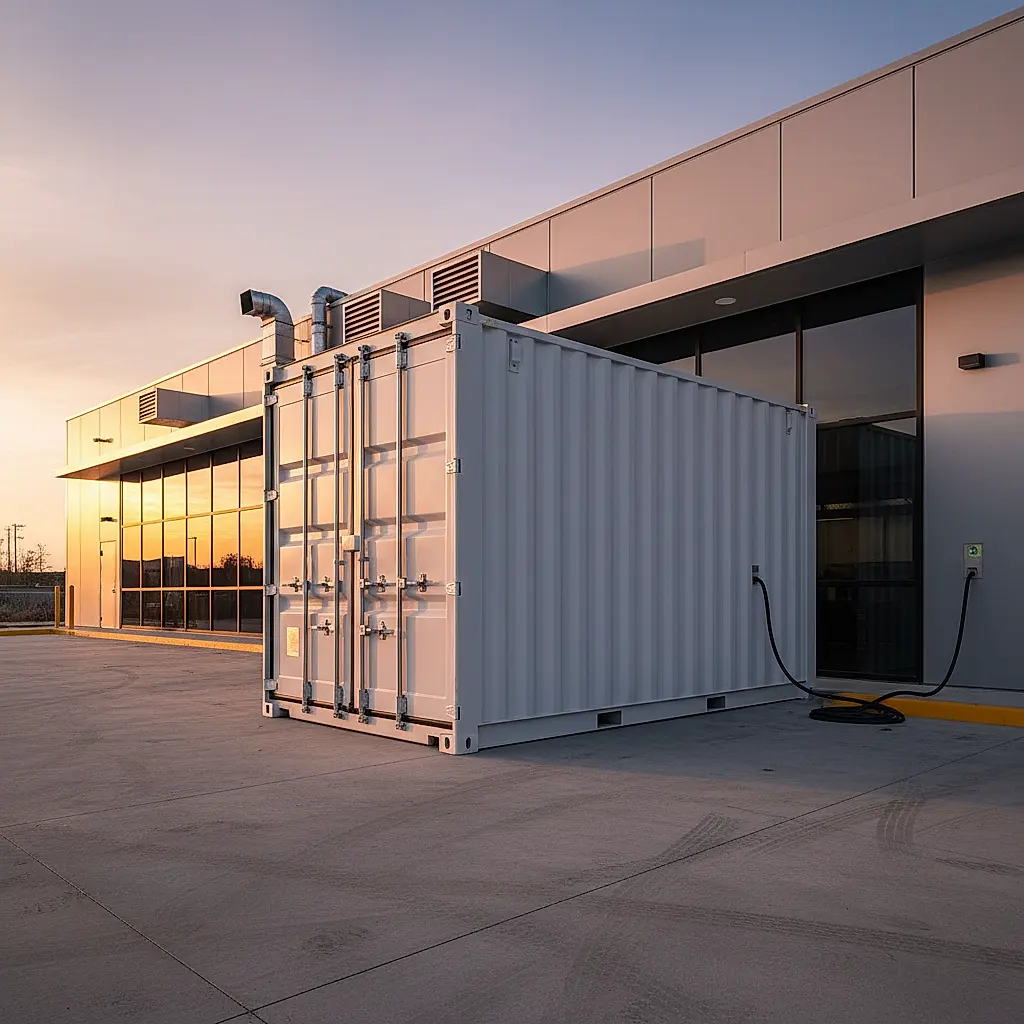
Deciding between a freezer container vs walk-in cooler cost often comes down to one question: are you paying for real estate or for refrigeration? As we enter August 2026, restaurant owners and food processors are facing a 12% rise in traditional construction labor, making fixed cold storage builds increasingly prohibitive. A built-in walk-in freezer requires specialized contractors, permanent floor space, and often, property tax reassessments. In contrast, portable cold storage prices for reefer containers offer a turnkey, modular alternative that can be depreciated as equipment rather than real estate.
Table of Contents

freezer container vs walk-in cooler cost: Direct Cost Comparison: Freezer Containers vs. Walk-In Coolers

When evaluating the commercial freezer unit cost, you must look beyond the sticker price. A standard 20ft refrigerated container provides roughly 1,000 cubic feet of storage. To get the same volume in a built-in walk-in, you aren't just buying panels; you're paying for specialized refrigeration plumbing, electrical runs, and concrete work.
| Feature | 20ft Reefer Container (Used/Refurb) | Fixed Walk-In Freezer (Built-In) |
|---|---|---|
| Average Purchase Cost | $8,500 – $14,000 | $22,000 – $45,000 |
| Installation Time | 1-2 Days (Electrical) | 3-6 Weeks (Construction) |
| Permit Requirements | Equipment/Temporary | Building/Structural/Electrical |
| Tax Status | Equipment Depreciation | Property Improvement |
| Mobility | High (Relocatable) | Zero (Fixed Asset) |
Breaking Down Portable Cold Storage Prices
The price of a single-phase 20ft refurbished refrigerated container usually includes the insulated box and the cooling machinery (Carrier, Thermo King, or Daikin). For businesses needing massive volume, a portable cold storage prices offers double the space for only a 30% increase in price. This economy of scale is why large-scale restaurant overflow refrigeration has shifted almost exclusively toward shipping containers.
Always verify the 'hours' on the compressor. Just like a truck engine, a refrigeration unit with 20,000+ hours will require more maintenance. We recommend refurbished units for critical food storage to ensure the CSC plate and cooling cycles are certified.
Outdoor Walk-In Cooler Alternative: The ROI of Mobility
One of the most overlooked aspects of the freezer container vs walk-in cooler cost debate is residual value. If your restaurant closes or moves, a built-in walk-in is a sunk cost—it stays with the building. A 40ft HC working refrigerated container is a liquid asset. You can sell it on the secondary market for 70-80% of its value years later. For those not ready to buy, reefer container leasing vs buying allows for seasonal scaling without the capital expenditure.
Permit and Zoning Considerations
Cold storage permit requirements vary by your local Authority Having Jurisdiction (AHJ). In many US counties, a shipping container is classified as 'temporary equipment.' This often bypasses the rigorous shipping container freezer conversion applied to permanent structures. However, you will still need a licensed electrician to handle the reefer container leasing vs buying, which typically involve a 460V 3-phase connection or a transformer for 230V single-phase power.
The Hidden Costs of Shipping Container Freezer Conversions
- Electrical Service Upgrades: Budget $1,500–$3,000 for a dedicated disconnect and circuit.
- Delivery Fees: Review our shipping container freezer conversion to account for tilt-bed or crane-off requirements.
- Site Prep: A level gravel or concrete pad is essential to ensure the doors seal correctly.
- Maintenance: Plan for annual refrigerant checks and coil cleanings, costing roughly $400/year.
Energy Efficiency Metrics: SEER Ratings vs. Insulation Thickness
When evaluating the long-term operational costs of cold storage, the thermal envelope of the structure plays a more significant role than the initial purchase price. Standard shipping container freezers, often referred to as reefers, are engineered with high-density polyurethane foam injected between stainless steel interior walls and aluminum or steel exteriors. This design minimizes thermal bridging, a common failure point in traditional stick-built walk-in coolers where wood or metal studs interrupt the insulation layer. For a standard 20-foot reefer, the R-value typically hovers around R-28 to R-32, which is significantly higher than the R-20 to R-25 found in many entry-level indoor walk-in panels. In climates with high ambient temperatures, such as the American Southwest, this increased thermal resistance translates to a 15% to 22% reduction in compressor cycle time, directly lowering monthly electricity expenditures.
Modern walk-in coolers, however, benefit from customizable insulation thicknesses. While a standard 4-inch panel is the industry benchmark, high-end walk-in units can be ordered with 5-inch or 6-inch panels to reach R-48 values. The trade-off is the cost per square foot; achieving these higher R-values in a traditional walk-in requires a premium investment that often exceeds the base price of a refurbished 40-foot high-cube reefer container. Furthermore, the floor construction of a shipping container freezer—typically featuring T-bar aluminum flooring—allows for superior airflow beneath the product. This forced convection ensures that the cooling unit does not have to work twice as hard to eliminate hot spots at the base of the unit, a frequent issue in flat-floored walk-in coolers that lack proper racking systems.
Utility costs are also influenced by the type of refrigeration system installed. Most shipping containers utilize integrated Carrier or Thermo King all-in-one units. These are built for the harsh maritime environment and are exceptionally durable, but they require a 460V 3-phase power supply in many instances, or a dedicated transformer for 230V applications. Conversely, smaller walk-in coolers can often run on standard 208/230V single-phase power, which is cheaper to install in residential or light commercial zones. Buyers must weigh the high efficiency of the industrial reefer against the potentially high electrical infrastructure costs required to support it. Over a five-year period, the energy savings of a well-insulated container often offset these setup costs, provided the throughput of goods remains high enough to justify the industrial-grade cooling capacity.
Beyond the insulation, air leakage represents the most significant 'silent' cost in cold storage. Walk-in coolers rely on vinyl gaskets and cam-lock panels that can shift over time, especially if the ground or floor settles. Once a gap of even a fraction of an inch appears, the compressor will run almost continuously to combat the influx of warm, moist air. Shipping containers are built as a single, rigid monocoque structure. The only points of failure for air leakage are the heavy-duty rear doors, which utilize industrial-grade rubber gaskets designed to withstand salt spray and extreme pressure. By maintaining a more consistent airtight seal, the container freezer maintains a more stable internal temperature, which is critical for businesses storing sensitive pharmaceuticals or high-value organic produce.
- Reefer Insulation: High-density sprayed polyurethane foam (closed-cell).
- Walk-In Insulation: Extruded polystyrene (XPS) or polyisocyanurate panels.
- Thermal Bridging: Minimal in containers due to continuous foam injection.
- Airflow Design: T-Bar flooring in containers vs. flat diamond plate in coolers.
- Structural Rigidity: Containers allow for crane placement without losing seal integrity.
Pro Tip: If placing a freezer container outdoors, paint the exterior with a ceramic-based solar reflective coating. This can reduce surface temperatures by up to 40 degrees, further lowering the energy demand on the refrigeration unit.
Site Preparation and Permitting: The Financial Ripple Effect
A major oversight in the freezer container vs. walk-in cooler cost debate is the expense associated with permanent versus temporary foundations. A walk-in cooler, specifically an outdoor model, requires a level concrete pad engineered to support the weight of the unit and its contents. This often involves excavation, rebar reinforcement, and professional concrete finishing, which can add $5,000 to $12,000 to the project before the cooler even arrives. Furthermore, because a walk-in cooler is often classified as a permanent building addition, it may trigger a reassessment of property taxes and require extensive building permits that take months to secure. These 'soft costs' are frequently excluded from the manufacturer's quote but are essential for an accurate ROI calculation. Freezer Container vs Walk-In Cooler Cost
Shipping container freezers offer a distinct advantage regarding site prep. Because they are designed to be portable and self-supporting, they can often be placed on a simple gravel bed or even industrial railroad ties (dunnage). This eliminates the need for a permanent concrete slab in many jurisdictions, classifying the unit as equipment rather than a permanent structure. This distinction is vital for tax purposes, as equipment can often be depreciated at an accelerated rate compared to real estate improvements. Additionally, the ability to relocate the unit means that if a business outgrows its current facility, the freezer container can be loaded onto a tilt-bed truck and moved to the new location for a few hundred dollars, whereas a traditional walk-in cooler is often a 'sunk cost' that must be abandoned or sold at a massive loss. Freezer Container vs Walk-In Cooler Cost
Permitting requirements vary wildly by municipality, but the 'temporary' nature of a shipping container often bypasses the need for intensive structural engineering reviews. In contrast, an indoor walk-in cooler must comply with strict health department regulations regarding floor coving, drainage, and NSF certification. While most reputable shipping container conversion companies ensure their interiors meet these standards, the process of certifying a custom-built walk-in can involve multiple inspections from plumbing, electrical, and fire safety officials. The time lost during these inspection windows represents an opportunity cost—every day the cold storage isn't operational is a day of lost revenue or increased spoilage risk for the business.
Finally, one must consider the cost of ventilation and environmental impact. An indoor walk-in cooler generates significant heat, which must be exhausted by the building's HVAC system. This puts an additional load on the existing infrastructure, leading to higher cooling bills for the entire facility. A shipping container freezer, situated outdoors, exhausts its heat directly into the atmosphere, bypassing the building's climate control system entirely. This separation of thermal loads is a major financial benefit for grocery stores, restaurants, and floral shops that want to keep their retail spaces comfortable without paying for the 'waste heat' generated by their industrial refrigeration equipment. Freezer Container vs Walk-In Cooler Cost
| Feature | Shipping Container (20ft Reefer) | Outdoor Walk-In (8x20) |
|---|---|---|
| Foundation Needs | Gravel or Railroad Ties | Reinforced Concrete Slab |
| Tax Classification | Equipment (Personal Property) | Leasehold Improvement (Real Property) |
| Mobility | High (Tilt-bed/Crane) | Low (Requires Disassembly) |
| Avg. Permitting Time | 1-3 Weeks | 4-12 Weeks |
| Typical Lifespan | 15-25 Years | 10-15 Years |
Warning: Always check local zoning ordinances before delivery. Some urban areas have specific aesthetics requirements for shipping containers, which may necessitate a custom wrap or siding to avoid daily fines. Freezer Container vs Walk-In Cooler Cost
Maintenance and Component Longevity Analysis
Maintenance costs represent the third pillar of the total cost of ownership. Shipping container refrigeration units are built for the 'set it and forget it' demands of international shipping. The components are heavy-duty and designed to operate in salt-heavy, high-humidity, and high-vibration environments. This over-engineering means that while parts for a Carrier ThinLINE or Daikin unit might be more expensive than residential-grade components, they fail far less frequently. A typical reefer compressor is rated for roughly 100,000 hours of operation. When a component does fail, the modular nature of the refrigeration unit allows for relatively quick replacement—often the entire motor or fan assembly can be swapped out without needing to open the refrigerant lines, which prevents contamination of the system. Freezer Container vs Walk-In Cooler Cost
In comparison, walk-in coolers often use split systems where the condenser is located on the roof and the evaporator is inside the unit. This requires a complex network of copper refrigerant lines that are susceptible to leaks at every joint and elbow. Finding a technician capable of troubleshooting these custom-plumbed systems can be difficult and expensive, especially during peak summer months when HVAC companies are backlogged. Because shipping container reefers are standardized globally, there is a massive network of certified marine refrigeration technicians. Even in landlocked states, the similarity to refrigerated trucking units (reefer trailers) means that most diesel and transport refrigeration mechanics can service these units with ease, often at a lower hourly rate than commercial HVAC specialists. Freezer Container vs Walk-In Cooler Cost
The interior maintenance of the two units also differs. Shipping containers feature stainless steel walls that are incredibly resistant to denting and scratching from forklifts or heavy pallet jacks. Walk-in coolers typically use thin-gauge aluminum or galvanized steel skins over the foam insulation. If a forklift operator clips a wall in a walk-in cooler, it can puncture the skin, leading to moisture ingress and 'ice heaving' within the insulation, which eventually destroys the panel's thermal integrity. The ruggedness of the shipping container allows for much more aggressive industrial use, making it the preferred choice for high-volume distributors and agricultural operations where heavy equipment is the norm. Over a ten-year cycle, the repair costs for physical damage to a shipping container are typically 60% lower than those for a standard walk-in cooler. Freezer Container vs Walk-In Cooler Cost
Lastly, the resale value provides a final 'hidden' financial benefit. A used shipping container reefer has a robust secondary market. Farmers, hunters, and small-scale food processors are always looking for affordable cold storage. Because the unit is a self-contained box, you can sell it and have it hauled away in a single afternoon. A walk-in cooler, however, has almost zero resale value once it is installed. The cost of labor to disassemble the panels, coupled with the inevitable damage that occurs during teardown, usually means the unit ends up in a scrap yard. When you buy a freezer container, you are investing in a liquid asset; when you build a walk-in cooler, you are making a permanent expenditure that you will likely never recover. Freezer Container vs Walk-In Cooler Cost
- 1Quarterly: Inspect door gaskets for cracks and clean debris from the condenser coils.
- 2Bi-Annually: Check refrigerant levels and ensure the floor drains are clear of ice buildup.
- 3Annually: Calibrate digital temperature sensors and test the emergency internal release handle.
- 4Every 5 Years: Perform a full diagnostic on the compressor and replace start capacitors if necessary.
If you are purchasing a used reefer, ask for a 'Pre-Trip Inspection' (PTI) report. This is an industry-standard diagnostic that ensures the unit can reach and hold -20°F for a sustained period. Freezer Container vs Walk-In Cooler Cost
Frequently Asked Questions
If you are preparing for a Q4 surge or expanding your facility's capacity, the freezer container vs walk-in cooler cost comparison clearly favors the flexibility of steel. By choosing a portable solution, you avoid the headaches of construction delays and permanent property alterations while gaining a reliable, high-performance asset. Freezer Container vs Walk-In Cooler Cost
If you're ready to compare inventory for your project, our team can pull matching units from our nationwide depots. Whether you need a 20ft domestic reefer for a tight urban site or a 40ft high cube for industrial storage, we provide full inspection reports and 2026 delivery logistics to ensure your cold chain remains unbroken. Freezer Container vs Walk-In Cooler Cost